Understanding ANL and ANLET
Telecoms are under constant pressure to reduce operating costs, improve service quality, and respond faster to network issues. In that environment, autonomous networks are not just a technology trend; they are becoming a strategic necessity.
Autonomous Network Level Evaluation Tool (ANLET) is an invaluable asset for telecoms moving from manual network management toward intelligent, self-managing network operations.
As networks grow more complex, ANLET provides a structured way to evaluate and measure network autonomy based on the Autonomous Network Level (ANL) model. It helps operators understand how autonomy develops and how they can progress in a measurable way.
Why Autonomous Networks Are Needed
Telecom networks now operate across multiple domains, vendors, services, and layers of infrastructure. This complexity makes traditional manual management slow, expensive, and difficult to scale. Operators can no longer rely on human intervention alone to maintain performance, reliability, and customer experience.
Autonomous networks are needed to address three major challenges:
- First, they help reduce operational complexity by automating routine and repetitive work.
- Second, they improve responsiveness by allowing networks to detect, analyze, and act on issues faster than humans can.
- Third, they support business growth by helping operators launch services more efficiently and create a more resilient operating model.
For telecom leaders, the need is not only technical. It is also commercial. Better automation means lower costs, fewer errors, improved service continuity, and stronger customer satisfaction.
The ANL Model
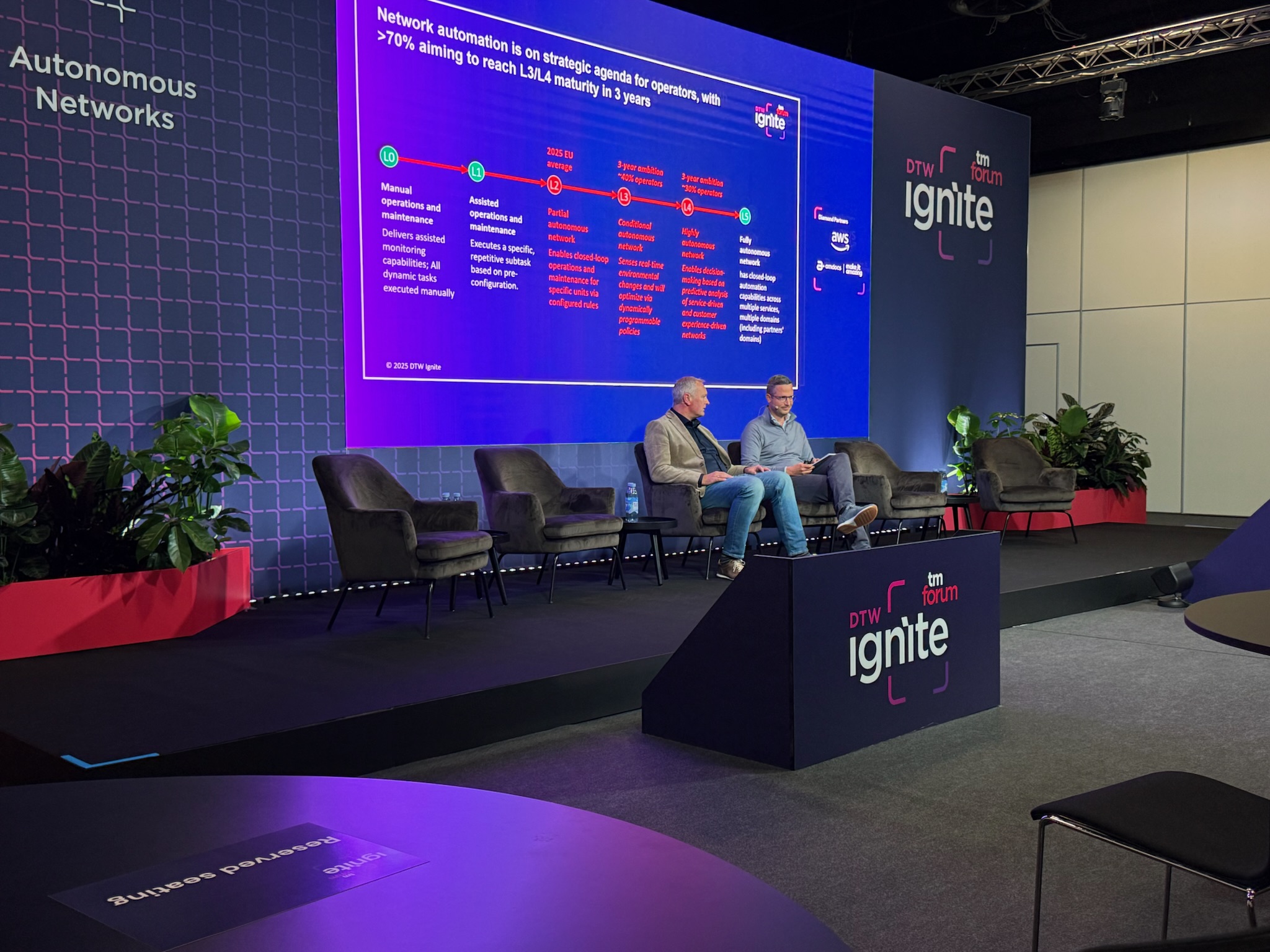
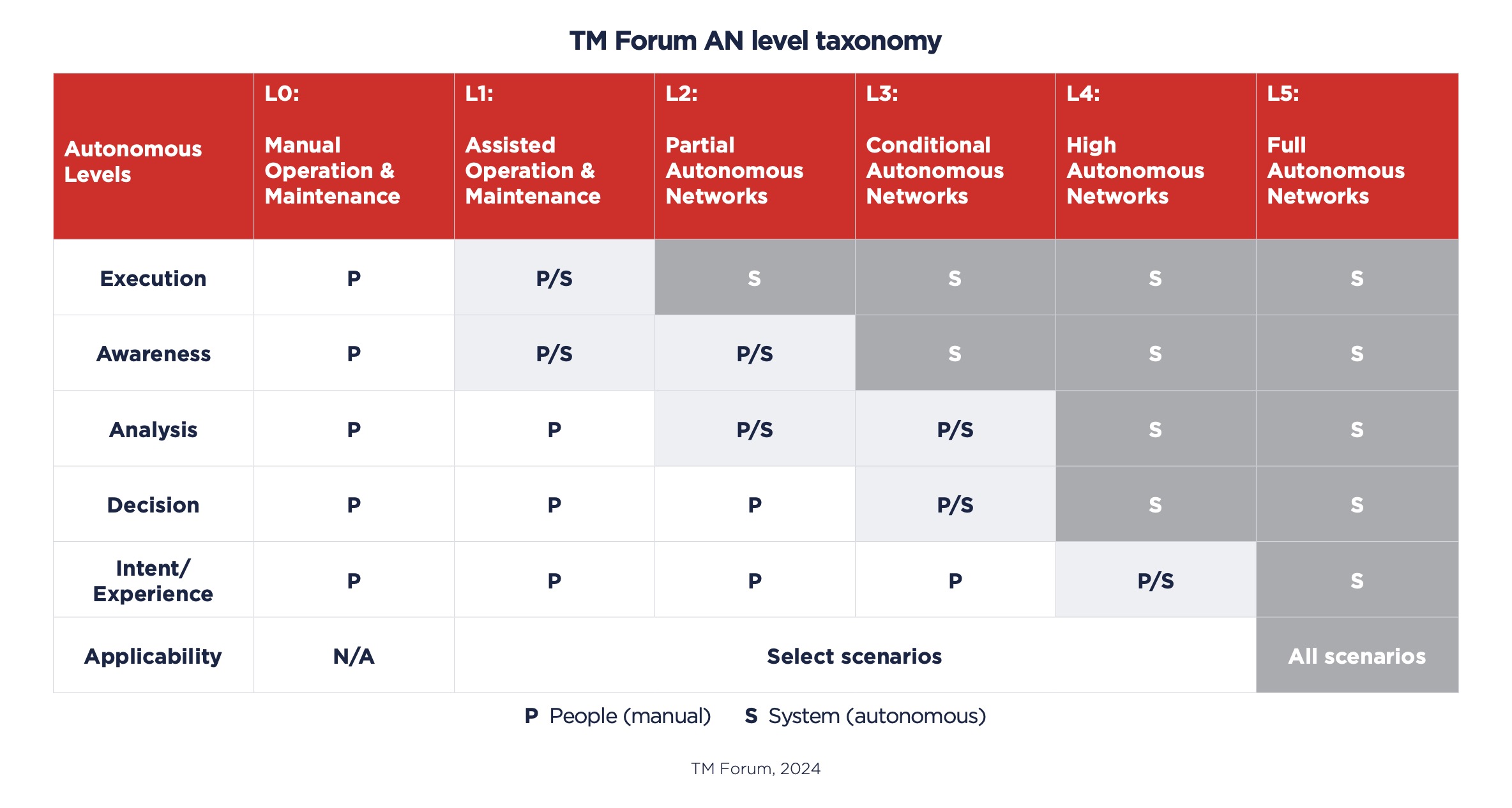
The Autonomous Network Level (ANL) model defines six levels of autonomy, from Level 0 to Level 5. It provides the classification framework used to describe how autonomous a network is. Each level represents a different balance between human control and system autonomy.
- Level 0 – Manual management: the system delivers assisted monitoring capabilities, which means all dynamic tasks must be executed manually.
- Level 1 – Assisted management: the system executes a certain repetitive sub-task based on pre-configuration to increase execution efficiency.
- Level 2 – Partially Autonomous Networks: the system enables partial automatic O&M for certain units based on pre-defined rules or policies under certain external environments.
- Level 3 – Conditionally Autonomous Networks: building on L2 capabilities, the system with awareness can sense real-time environmental changes, and in certain network domains, optimize and adjust itself to the external environment.
- Level 4 – Highly Autonomous Networks: building on L3 capabilities, the system enables, in a more complicated cross-domain environment, analysis and decision-making based on predictive or active closed-loop management of service and customer experience-driven networks.
- Level 5 – Fully Autonomous Networks: this level is the goal for telecom network evolution. The system possesses closed-loop automation capabilities across multiple services, multiple domains and the entire lifecycle, achieving Autonomous Networks.
Source: Autonomous Networks Framework v2.0.0 (IG1218F), TM Forum.
The ANL model is the foundation of ANLET. It provides the classification system that turns network autonomy from a vague ambition into a clear and measurable maturity framework.
The ANL model also supports a closed-loop view of operations through the IAADE loop: Intention, Awareness, Analysis, Decision, and Execution. This makes it easier to evaluate whether a process is still human-led or has become genuinely autonomous.
Why the ANL Classification Matters
One of the biggest strengths of the ANL model is that it gives telecom operators a standard way to classify network autonomy. Without such a framework, it would be difficult to compare progress across networks, vendors, or business units.
It also helps operators benchmark their current state. A CSP can assess whether a fault management process is still manual, partially automated, or moving into predictive and self-correcting behavior according to the ANL classification. That makes planning more practical and less abstract.
The ANL model also supports the evolutionary path toward autonomy. Instead of trying to jump directly to full automation, operators can move step by step, building capabilities in a controlled and stable way. This reduces risk and improves adoption while progressing through the autonomy levels.
ANLET: Autonomous Network Level Evaluation Tool
Evaluating Autonomous Network Levels (ANL) is not a simple task. While the industry continues to advance toward autonomous operations, many CSPs still face challenges related to standardization, tool availability, and assessmentconsistency. Without a structured evaluation approach, it can be difficult to understand current capabilities, compare progress, or identify the next steps in the autonomy journey.
This is where ANLET comes in.
ANLET is designed to assess network capabilities against the ANL model and determine the level of autonomy achieved. By providing a consistent and repeatable evaluation methodology, it transforms network autonomy from a conceptual objective into something measurable and actionable.
Rather than simply describing a network as “automated” or “autonomous”, operators can use ANLET to identify its ANL classification and understand what capabilities are required to progress further. This provides a solid foundation for planning investments, prioritizing initiatives, and tracking transformation outcomes over time.
ANLET also creates a common language across the organization. Network engineers, operations teams, architects, and business leaders can all align around the same assessment framework, making it easier to communicate goals, measure progress, and coordinate transformation efforts.
Business Value of ANLET for Telecom Leaders
For telecom executives, ANLET is invaluable because it links technical maturity to business outcomes. By measuring a network’s autonomy level against the ANL model, it helps define where automation creates measurable value and where further investment is needed.
The benefits include lower operating costs, faster issue resolution, better service continuity, and improved customer experience. It also supports compliance, training, and innovation by giving organizations a common framework for understanding and measuring network autonomy.
ANLET is especially relevant for transformation programs because it helps leaders answer practical questions:
- Where are we today?
- What ANL level has our network achieved?
- What capabilities are missing?
- What should we prioritize next?
The journey toward autonomous networks is not defined by technology alone. Success depends on an organization’s ability to understand its current capabilities, measure progress objectively, and make informed decisions about where to invest next.
This is where ANL and ANLET work together. The ANL model provides the classification framework that defines network autonomy, while ANLET provides the practical means to evaluate and measure that autonomy consistently across domains, processes, and organizations.
As telecom networks become more dynamic, distributed, and service-driven, the ability to accurately assess autonomy will become increasingly important. Operators that can clearly measure where they are today will be better positioned to accelerate transformation, improve operational efficiency, and unlock the full value of autonomous networking.
In that sense, ANLET is more than an assessment tool. It is an enabler of the autonomous network journey, helping CSPs turn ambition into measurable progress and measurable progress into business value.
To better understand your network’s current autonomy level and define a practical roadmap for autonomous network transformation, Makman offers the ANLET assessment service to evaluate your network against the ANL model, identifies capability gaps, benchmarks your current state, and delivers actionable recommendations aligned with your business objectives. Whether you are taking the first steps toward autonomy or accelerating an existing transformation program, we can help you move forward with confidence through a structured, outcome-driven approach.
 The AN Upskilling Hub (ANUH) represents a deliberate move toward a more realistic model of capability development. Built through collaboration between the founding members of the Hub: Huawei and Ericsson (as technology vendors), Makman Technology Consulting (as a specialist integrator), and TM Forum (a vendor-agnostic standards and certification body), it introduces a blended approach to learning aligned with real-world deployment environments. And as the hub matures, more partners will be invited to join.